
There Is No Such Thing as “No Risk” in Investing
One of the most common conversations I have with clients revolves around a simple question: what is risk?
For many investors, risk is defined primarily as volatility. When markets decline and account balances temporarily drop, it feels uncomfortable, and that discomfort is often interpreted as risk. As a result, the instinctive reaction is to seek stability by moving money into cash, money market funds, CDs, or short-term bonds where the account value appears steady and predictable.
At first glance, this can feel like eliminating risk. But in reality, risk does not disappear. It simply changes form.
The Risk Many Investors Overlook: Inflation
For someone planning a retirement that could last 25 to 30 years or longer, the biggest financial threat is often not short-term market volatility. Instead, it is inflation and the gradual erosion of purchasing power over time.
Inflation may appear modest from year to year, but its cumulative impact across decades can be substantial. Historically, inflation in the United States has averaged around 3 percent per year. At that rate, the cost of living roughly doubles every 24 years. In practical terms, that means a lifestyle that costs $80,000 today could require approximately $160,000 in two decades simply to maintain the same standard of living.
If a portfolio is invested entirely in assets that produce fixed income that does not grow over time, the purchasing power of that income gradually declines. The number of dollars may remain constant, but what those dollars can actually buy steadily shrinks.
Stability Today vs. Purchasing Power Tomorrow
This highlights an important tradeoff investors face. It is entirely possible to construct a portfolio that appears very stable in the short run. Cash, CDs, and short-term bonds generally fluctuate very little from month to month, which can create a sense of security today.
However, that stability can come at a cost if the income produced by those assets fails to keep pace with inflation over time.
The alternative approach involves accepting some short-term volatility in pursuit of long-term growth. Equities certainly fluctuate along the way. Markets experience corrections, bear markets, recessions, and periods of uncertainty. However, over long periods of time, businesses tend to grow earnings, raise prices, and increase dividends. That growth has historically helped investors maintain and often increase their purchasing power.
A 60-Year Perspective on Markets, Income, and Inflation
One way to see this dynamic more clearly is by looking at the experience of someone approaching retirement today.
Someone turning 62 in 2026 was born in 1964. Over the course of their lifetime, the S&P 500 rose from about 85 to more than 6,800. That represents roughly an eighty-fold increase in market value.
More importantly for retirees who depend on income, dividends paid by the companies in the index increased from approximately $2.58 per share in 1964 to more than $78 per share in 2025. That represents about thirty times more income.
Over that same period, consumer prices increased roughly tenfold.
The relationship between these three figures tells an important story about long-term investing.
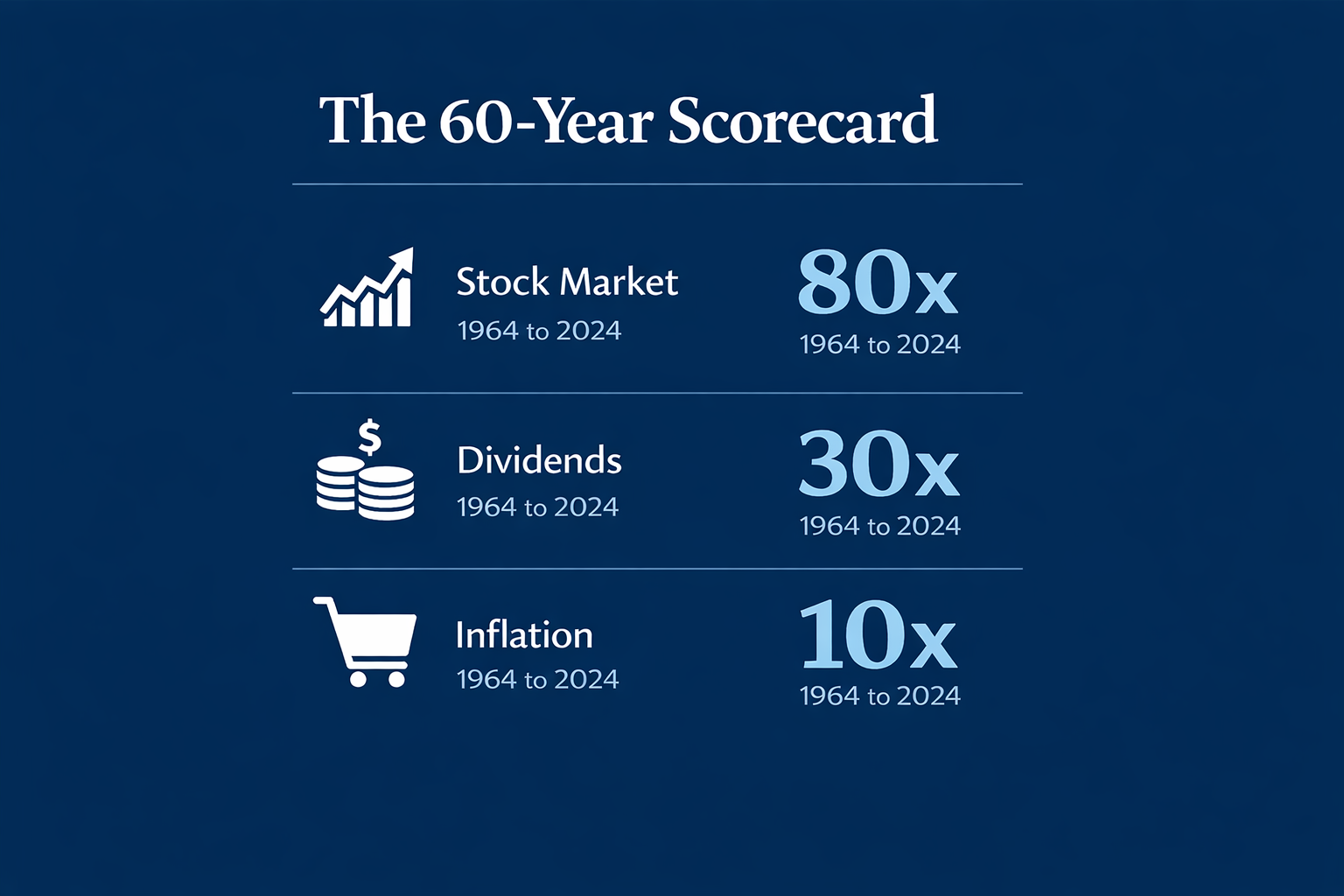
Over the past six decades:
- The stock market increased roughly 80x
- Dividend income increased roughly 30x
- The cost of living increased roughly 10x
Markets Rise Through Crisis
Markets did not move upward in a straight line during that time. Investors lived through the Vietnam War, the oil shocks of the 1970s, double-digit inflation, the crash of 1987, the dot-com bubble, the global financial crisis, the COVID pandemic, and numerous geopolitical conflicts.
In fact, the stock market was cut roughly in half multiple times during those decades.
Despite those disruptions, the long-term trajectory remained remarkably consistent. Businesses continued to innovate, grow earnings, and increase the income they returned to shareholders.
The Real Choice Investors Face
The broader lesson is that there is no such thing as a portfolio without risk. The real choice investors face is deciding which type of risk they are willing to accept.
Investors who prioritize short-term stability may avoid volatility today, but they assume the risk that inflation gradually erodes their purchasing power over time. Investors who accept some volatility in pursuit of long-term growth take on uncertainty today in exchange for a higher likelihood that their portfolio will maintain its purchasing power decades into the future.
Neither approach eliminates risk. It simply determines when that risk appears in your financial life.
Why This Matters for Modern Retirements
This tradeoff has become even more important as retirements continue to lengthen. A healthy 65-year-old couple today has a meaningful chance that one spouse will live into their 90s. That means their retirement portfolio may need to support spending for thirty years or more.
Over that kind of time horizon, inflation becomes a powerful force that can quietly undermine a financial plan if it is not properly addressed.
For that reason, most well-designed retirement portfolios incorporate both stability and growth. The goal is not to eliminate volatility entirely. Instead, the objective is to build a strategy that balances short-term resilience with long-term growth so that purchasing power can be sustained throughout retirement.
Because ultimately, successful investing is not just about preserving dollars. It is about preserving what those dollars will allow you to do many years from now.